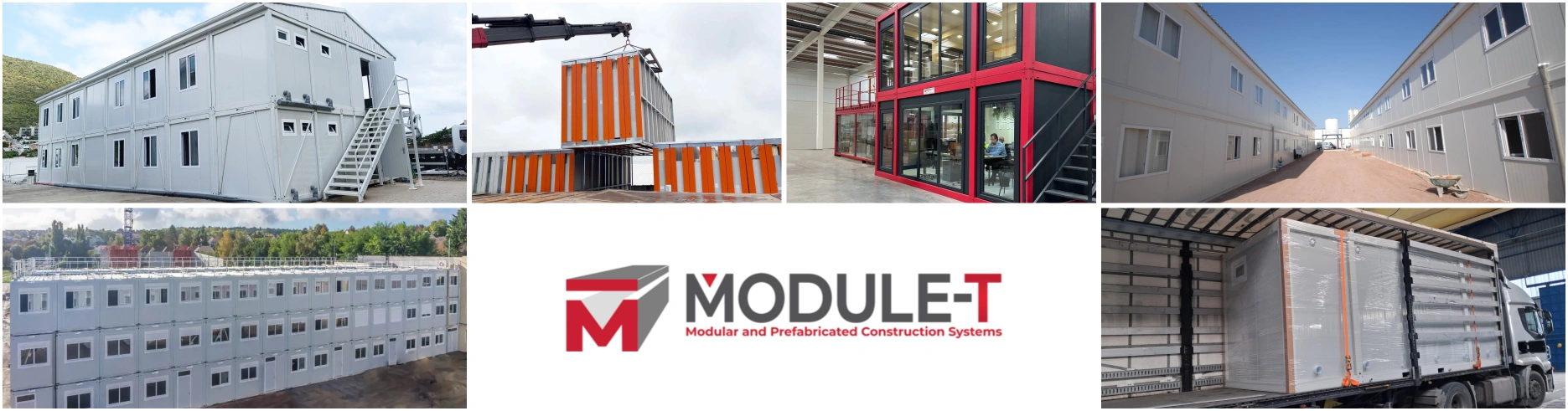
Module-T modular buildings can be designed with a maximum of 3 storeys. However, two-storey configurations are the most common in our projects.
Frequently Asked Questions
We ask the client to provide a simple drawing or preliminary layout showing their requirements. It does not need to be a professional architectural drawing; the purpose is to understand the client's needs clearly and prepare the most suitable layout.
Our engineering team carries out detailed structural calculations in accordance with American and European standards, taking into account the conditions of the region where each project will be installed.
In areas exposed to high wind speeds, project-specific wind loads are assessed and the necessary structural reinforcements are designed accordingly. This helps ensure that our buildings are safe, durable and long-lasting even under challenging climate conditions.
Yes. Depending on the product model and project requirements, electrical installations, lighting, clean and wastewater systems and sanitary equipment are included in the standard Module-T offer.
All systems are prepared according to the technical requirements of the project and the electrical standards of the destination country.
Connections to the main electricity, clean water and wastewater infrastructure on site are the client's responsibility.
Installation is carried out by the client's own team or by local installation teams. Module-T supports the process with project-specific installation drawings, installation manuals and application videos.
Remote technical support can also be provided when required. Upon request, a technical supervisor can be assigned at an additional cost to guide local teams on site during the installation process.
Module-T provides detailed installation drawings, panel layout plans, electrical plans, clean and wastewater installation plans, as well as floor and foundation layout plans according to the technical requirements of each project.
Installation manuals and application videos are also provided to help local teams complete the assembly correctly, safely and efficiently.
Yes. Module-T organises modular building deliveries throughout Europe and worldwide.
Our products are shipped in only two formats: flatpack (dismantled) or monobloc (fully assembled).
Monobloc modules are mainly transported by truck throughout Europe. Flatpack modules can be shipped throughout Europe and worldwide, including Africa, the Caribbean and the Americas, mainly using international container transport.
The most commonly used Incoterms are:
- EXW (Ex Works): the client organises transportation from our factory.
- CIF (Cost, Insurance and Freight): Module-T organises sea freight and insurance up to the agreed destination port.
Other delivery terms can be evaluated according to project requirements.
Flatpack systems are particularly suitable for large-scale projects because they optimise transportation costs and make logistics more efficient.
A single 40 HC shipping container can accommodate 10 standard 2.40 × 6.00 m flatpack modules without interior equipment.
This allows more modules to be transported using fewer shipping containers and simplifies the logistics of large projects.
Yes. Module-T flatpack modular buildings are designed to be dismantled, transported to another project site and reassembled when required.
This is particularly advantageous for temporary construction sites, worker camps and projects operating at different locations. The structural components and connections should be checked before reinstallation.
Yes. Module-T modular building systems can be designed to expand as project requirements change.
As long as the technical specifications, structural system and layout of the existing building are compatible, additional modules can be added to increase office, accommodation, social or other functional areas.
Module-T modular buildings can be installed on concrete blocks or a flat concrete surface, depending on the technical requirements of the project.
Before installation, the ground must be level, stable and capable of safely supporting the total load of the structure.
The necessary foundation and site layout drawings are provided to the client as part of the project.
Module-T quotations are generally prepared excluding VAT. Transportation and delivery scope depend on the agreed delivery terms.
Under CIF delivery terms, sea freight and insurance up to the agreed destination port are organised by Module-T.
Crane unloading and on-site handling remain the client's responsibility unless otherwise specified in the quotation.
Module-T quotations include the selected modular building model and the technical equipment defined for the project.
Depending on the project, electrical installations, lighting, clean and wastewater systems, insulation and other equipment may be included.
Unless otherwise stated, site preparation, foundation works, unloading, installation, external utility connections and local permits remain the client's responsibility.
Buying directly from a manufacturer such as Module-T allows customers to obtain solutions tailored to the specific requirements of their project.
Dimensions, interior layouts, insulation, colours, door and window arrangements, and electrical and sanitary equipment can be adapted to project requirements.
Technical design, production, documentation and international logistics can also be coordinated directly with the manufacturer.
The price of a new 15 m² site cabin depends on factors such as the delivery method, insulation level and integrated equipment.
As an indication, a standard 15 m² Module-T site cabin with 50 mm polyurethane insulated sandwich panels starts from:
- €3,000 excluding VAT for a flatpack unit to be assembled on site.
- Approximately €6,000 excluding VAT for a monobloc unit delivered fully assembled in France or Europe.
These prices are indicative and may vary according to destination, transportation costs, insulation thickness and selected equipment.
The cost of a modular building cannot be determined solely according to its floor area.
The price depends on factors such as the building configuration, number of modules, equipment, insulation level, number of storeys and the climatic or structural requirements of the project. You can get more information from https://module-t.com/prices/ .
Transportation and installation costs also vary depending on the delivery method, site accessibility and handling equipment required.
Each Module-T project is therefore evaluated individually.
The cost of a complete worker camp for 20 people depends on its configuration, equipment and delivery method.
As an indication, a camp without accommodation may consist of approximately 14 to 15 twenty-foot modules, including offices, sanitary facilities, changing rooms and a dining area.
Estimated budget:
- €40,000–€60,000 excluding VAT for flatpack delivery.
- €80,000–€100,000 excluding VAT for pre-assembled modules.
These figures are indicative and may vary according to equipment, insulation, destination and the technical requirements of the project.
Module-T designs and manufactures customised modular worker camps for construction, industrial and large infrastructure projects
Module-T products are shipped in two formats: flatpack (dismantled) or monobloc (fully assembled). Flatpack modules are assembled on site, while monobloc modules are delivered already assembled.
Yes. Module-T can deliver monobloc modules by truck throughout Europe. This method is widely used for European projects where fully assembled modules are preferred.
Flatpack modules can be shipped throughout Europe and worldwide, including Africa, the Caribbean and the Americas. Their dismantled format provides a significant logistics advantage, especially for long-distance and overseas projects.
Yes. Flatpack modules are not limited to overseas projects and can also be supplied for projects throughout Europe. The delivery format can be selected according to the project size, installation plan and logistics requirements.
The most suitable delivery format depends on the project location, number of modules, transport distance and on-site installation conditions. Monobloc delivery is frequently preferred for European projects, while flatpack systems offer major logistics advantages for large-scale and international projects.
Transporting modules in dismantled flatpack form makes more efficient use of shipping capacity, particularly for long-distance deliveries. This makes flatpack systems especially advantageous for large-scale and overseas projects.
Monobloc modules are shipped fully assembled. Therefore, the main structural assembly required for flatpack systems is not needed on site. Positioning and external utility connections are carried out according to the project scope.
Flatpack modules arrive at the project site in dismantled form and are assembled by local teams using project-specific installation drawings, manuals and Module-T technical support. A technical supervisor can also be provided upon request.