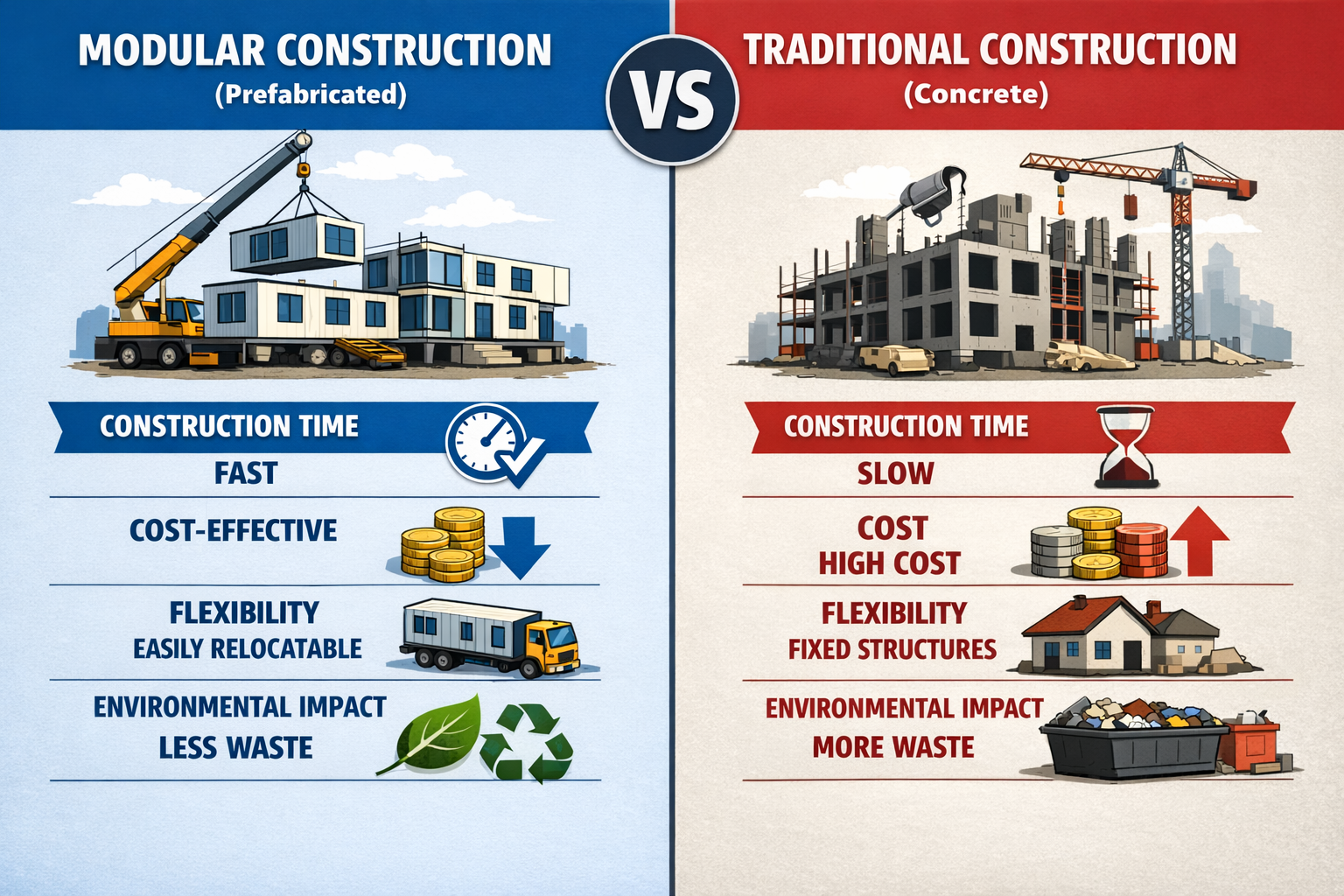
Many companies are now turning to modular construction as a time and cost-effective alternative to traditional builds. Module-T is often asked to explain which is better, a settled building or a modular building. To understand the answer, you first need to grasp what modular construction is and the differences between a prefabricated modular building and a conventional structure.
Modular building is a prefabricated construction method where the building process is conducted off-site and then delivered to a location for assembly and use. The building is made in specific sections called “modules”’ that, once joined, form a complete and fully operational structure. These modular constructions can be placed side by side, stacked, or inter-connected to create all the rooms and space you need, and you can highly customise them to suit almost any commercial or residential purpose.
Modular buildings are gaining popularity. The advent of energy-efficient, sustainable materials and significant technological advances have helped revamp prefabricated design and manufacturing processes, and modular constructions are now seen as far more than simply a low-budget building solution. There are several differences between the two building processes. These include:
One of the main differences between modular and conventional construction is that modular buildings can be moved, whereas traditional buildings stay put in one location. Modular structures can be temporary or permanent and can be assembled, dismantled, and relocated many times, which makes them perfect for use on temporary sites such as labour camps, construction sites, military and civilian sites, mining, and industrial facilities.
Modular buildings use lean manufacturing processes and are made off-site in a highly controlled environment. Up to 90% of the build is done remotely, and the structure is then divided into sections and transported to your site for final assembly. It eliminates costly on-site weather delays and disruption and dramatically reduces time, waste, and labour costs. The sections arrive pre-painted, pre-fitted with utility connections and sockets, and customised according to your preference, meaning you can use the space quickly, and in most cases, you can have the buildings up and running in just a few hours or within a couple of days after delivery.
Customising a traditional build requires a team of contractors to paint, fit and prepare the building for use, which takes considerable time and money. In contrast, a prefabricated building is designed in advance and delivered with many features already in place. Most alterations are made in the factory, and the modular structures come with windows, flooring, security features, power and technology connections, sewage lines, air conditioning, telecommunications systems, and many other components.
Modular buildings meet (and often exceed) the same standards and codes as traditional buildings. In the same manner that conventional constructions need to meet quality and safety guidelines, modular buildings also undergo regular inspections to ensure the quality and safety of the building. During traditional construction, plans are approved, and inspectors visit the location at critical points throughout the process. In contrast, these tests are streamlined and quick with off-site and modular structures due to the use of state-of-the-art technology and machinery. Inspections are made as the modules are on the assembly line, so any problems or imperfections can be quickly addressed. This process takes far less time and results in delivering a precise, high-quality product that adheres to UK, EU, and US building codes and regulations.
Another significant difference is that modular builds can be shipped to remote areas where constructing a conventional building may not be possible. Prefabricated buildings can be quickly assembled in areas of extreme climatic change, such as deserts or extremely humid or wet locations. They also meet seismic and cyclonic building standards, plus extra insulation can be used, so they can even be used in areas prone to hurricanes, cyclones, and earthquakes.
A wide range of standard modular buildings is available, all of which can be customised to suit your style and purpose. Popular modular structures include office and accommodation buildings, dormitories, WC and sanitary buildings, restaurant and canteen buildings, locker rooms, shower facilities, industrial hangers, school rooms, and infirmaries. Smaller standard buildings include guard houses and security kiosks, flatpack showroom containers, booths, and shops. Please see the Module-T website for our complete product range.
Time is critical in any build, and the time you save by ordering a modular building is attractive as you can enjoy a quick return on your investment. Modular building means you can simultaneously lay the foundations necessary at the site whilst the building is being made in the factory, saving considerable time and up to 50% in many cases.
The differences between conventional and modular buildings are now apparent, so you can judge which construction is the best for you.
Factory-built modular constructions are enjoying new popularity for a good reason – they offer a high-quality, fast, and budget-friendly alternative to stick-built structures. In commercial terms, time equals money, so the time savings involved in modular construction means you enjoy a quicker return on your investment. This leaves modular buildings the most affordable and practical option for many industrial and commercial purposes, especially if you need space quickly or only plan to be at a location for a short duration.
Please get in touch with us if you want to know more about modular buildings or have any questions regarding the differences between traditional and prefabricated buildings. Order your prefabricated building from Module-T, the leading modular building company!
To receive a quote quickly, please fill in the customer request form. Our sales representatives will contact you as soon as possible.
PROTECTION OF PERSONAL DATA
WEBSITE COOKIE POLICY
Your personal data; as the data controller,Module-t operates the website (https://module-t.com/), and protecting the privacy of visitors to this website is one of our institution’s core principles. This Cookie Usage Policy (“Policy”) explains to all website visitors and users the types of cookies used and under what conditions.
Cookies are small text files stored on your device or network server by websites you visit through your computer or mobile device.
They are generally used to provide you with a personalized experience while using the website you visit, improve the services offered, and enhance your experience, contributing to ease of use while browsing a website. If you prefer not to use cookies, you can delete or block cookies through your browser settings. However, we would like to remind you that this may affect your use of our website. Unless you change your cookie settings in your browser, we will assume that you accept the use of cookies on this site.
1. WHAT TYPES OF DATA ARE PROCESSED İN COOKIES?
On websites, depending on the type of cookie, data related to your browsing and usage preferences on the device you use to visit the site is collected. This data includes information about the pages you accessed, the services and products you viewed, your preferred language option, and other preferences.
2. WHAT İS A COOKIE AND WHAT ARE ITS PURPOSES?
Cookies are small text files stored on your device or network server through browsers by the websites you visit. These small text files, which contain your preferred language and other settings on the site, help remember your preferences on your next visit and assist us in improving our services to enhance your experience on the site. This way, you can have a better and more personalized experience on your next visit.
The main purposes of using cookies on our website are listed below
The main purposes of using cookies on our website are as follows:
3. TYPES OF COOKIES USED ON OUR WEBSITE
3.1. Session Cookies
Session cookies ensure that the website functions properly during your visit. They are used for purposes such as maintaining security and continuity during your visit. Session cookies are temporary and are deleted once you close your browser or revisit the site.
3.2. Persistent Cookies
These cookies are used to remember your preferences and are stored on your device through browsers. Even after you close your browser or restart your computer, persistent cookies remain unless deleted through your browser settings.
Some types of persistent cookies can be used to provide personalized recommendations based on your usage of the website.
With persistent cookies, if you revisit our website with the same device, it checks whether there is an existing cookie created by our website. If so, it recognizes that you have previously visited and customizes the content accordingly to offer you better service.
3.3. Essential/Technical Cookies
These are essential cookies required for the proper functioning of the website. The purpose of these cookies is to provide necessary services by ensuring the website operates correctly. For example, they enable access to secure sections of the site and allow navigation and feature usage.
3.4. Analytical Cookies
These cookies collect information on how the website is used, such as visit frequency and numbers, and how visitors reach the site. Their purpose is to improve the website’s functionality, enhance performance, and analyze trends. These cookies do not contain data that can identify visitors. For example, they indicate the number of error messages displayed or the most visited pages.
3.5. Functional Cookies
These cookies remember the choices made by visitors on the site and retain them for future visits. Their purpose is to provide users with ease of use. For instance, they prevent users from re-entering their passwords on every page they visit.
3.6. Targeting/Advertising Cookies
These cookies measure the effectiveness of ads displayed to visitors and track the number of times an ad is shown. Their purpose is to provide personalized ads based on visitors’ interests.
Similarly, they track browsing behavior to identify visitors’ interests and offer relevant content. For example, they prevent an ad from being repeatedly shown within a short period.
4. HOW TO MANAGE COOKIE PREFERENCES?
To change your preferences regarding cookie usage, block, or delete cookies, you can adjust your browser settings.
Additionally, previously stored cookies can be deleted.
If you disable or reject cookies, you may need to adjust some preferences manually, and some features and services on the website may not function properly as we will not be able to recognize and associate your account.
You can modify your browser settings by clicking the relevant link in the table below.
5. EFFECTIVENESS OF THE WEBSITE PRIVACY POLICY
The Website Privacy Policy is effective as of January 13, 2025 . If any part of the policy or specific provisions are updated, the effective date will be revised accordingly. The Privacy Policy is published on the Institution’s website (module-t.com) and is made available to personal data owners upon request.
Company Name: Module-t
Address: Cevizli Mah. Cevizli D-100 Güney Yanyol Cad. No:2 Kuriş Kule Kartal / Istanbul – Turkey
Phone: +90 216 441 01 77
E – Mail: [email protected]
Website Address: www.module-t.com
PROTECTION OF PERSONAL DATA
WEBSITE COOKIE POLICY
Your personal data; as the data controller,Module-t operates the website (https://module-t.com/), and protecting the privacy of visitors to this website is one of our institution’s core principles. This Cookie Usage Policy (“Policy”) explains to all website visitors and users the types of cookies used and under what conditions.
Cookies are small text files stored on your device or network server by websites you visit through your computer or mobile device.
They are generally used to provide you with a personalized experience while using the website you visit, improve the services offered, and enhance your experience, contributing to ease of use while browsing a website. If you prefer not to use cookies, you can delete or block cookies through your browser settings. However, we would like to remind you that this may affect your use of our website. Unless you change your cookie settings in your browser, we will assume that you accept the use of cookies on this site.
1. WHAT TYPES OF DATA ARE PROCESSED İN COOKIES?
On websites, depending on the type of cookie, data related to your browsing and usage preferences on the device you use to visit the site is collected. This data includes information about the pages you accessed, the services and products you viewed, your preferred language option, and other preferences.
2. WHAT İS A COOKIE AND WHAT ARE ITS PURPOSES?
Cookies are small text files stored on your device or network server through browsers by the websites you visit. These small text files, which contain your preferred language and other settings on the site, help remember your preferences on your next visit and assist us in improving our services to enhance your experience on the site. This way, you can have a better and more personalized experience on your next visit.
The main purposes of using cookies on our website are listed below
The main purposes of using cookies on our website are as follows:
3. TYPES OF COOKIES USED ON OUR WEBSITE
3.1. Session Cookies
Session cookies ensure that the website functions properly during your visit. They are used for purposes such as maintaining security and continuity during your visit. Session cookies are temporary and are deleted once you close your browser or revisit the site.
3.2. Persistent Cookies
These cookies are used to remember your preferences and are stored on your device through browsers. Even after you close your browser or restart your computer, persistent cookies remain unless deleted through your browser settings.
Some types of persistent cookies can be used to provide personalized recommendations based on your usage of the website.
With persistent cookies, if you revisit our website with the same device, it checks whether there is an existing cookie created by our website. If so, it recognizes that you have previously visited and customizes the content accordingly to offer you better service.
3.3. Essential/Technical Cookies
These are essential cookies required for the proper functioning of the website. The purpose of these cookies is to provide necessary services by ensuring the website operates correctly. For example, they enable access to secure sections of the site and allow navigation and feature usage.
3.4. Analytical Cookies
These cookies collect information on how the website is used, such as visit frequency and numbers, and how visitors reach the site. Their purpose is to improve the website’s functionality, enhance performance, and analyze trends. These cookies do not contain data that can identify visitors. For example, they indicate the number of error messages displayed or the most visited pages.
3.5. Functional Cookies
These cookies remember the choices made by visitors on the site and retain them for future visits. Their purpose is to provide users with ease of use. For instance, they prevent users from re-entering their passwords on every page they visit.
3.6. Targeting/Advertising Cookies
These cookies measure the effectiveness of ads displayed to visitors and track the number of times an ad is shown. Their purpose is to provide personalized ads based on visitors’ interests.
Similarly, they track browsing behavior to identify visitors’ interests and offer relevant content. For example, they prevent an ad from being repeatedly shown within a short period.
4. HOW TO MANAGE COOKIE PREFERENCES?
To change your preferences regarding cookie usage, block, or delete cookies, you can adjust your browser settings.
Additionally, previously stored cookies can be deleted.
If you disable or reject cookies, you may need to adjust some preferences manually, and some features and services on the website may not function properly as we will not be able to recognize and associate your account.
You can modify your browser settings by clicking the relevant link in the table below.
5. EFFECTIVENESS OF THE WEBSITE PRIVACY POLICY
The Website Privacy Policy is effective as of January 13, 2025 . If any part of the policy or specific provisions are updated, the effective date will be revised accordingly. The Privacy Policy is published on the Institution’s website (module-t.com) and is made available to personal data owners upon request.
Company Name: Module-t
Address: Cevizli Mah. Cevizli D-100 Güney Yanyol Cad. No:2 Kuriş Kule Kartal / Istanbul – Turkey
Phone: +90 216 441 01 77
E – Mail: [email protected]
Website Address: www.module-t.com