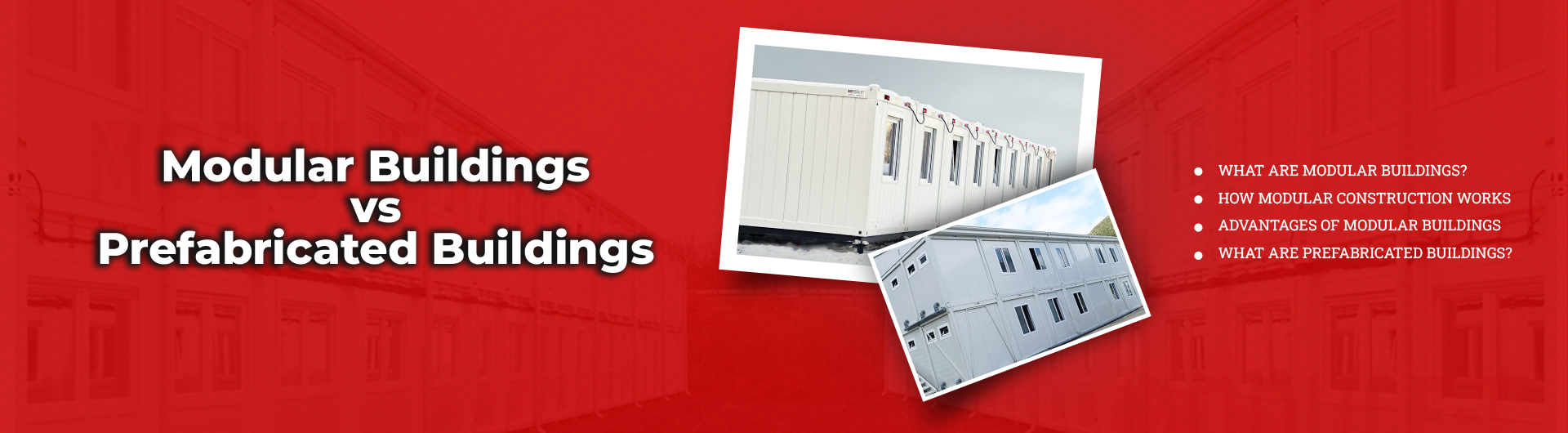
In the dynamic landscape of the global construction industry, a significant shift is underway, moving away from the time-intensive and often wasteful practices of traditional construction. As stakeholders increasingly prioritize efficiency, cost-effectiveness, and sustainability, offsite manufacturing techniques have emerged as transformative solutions.
Central to this evolution are the terms “modular buildings” and “prefabricated buildings.” While frequently used interchangeably, these terms represent distinct, albeit related, construction methodologies. A thorough understanding of their differences is not merely academic; it is crucial for making informed decisions that align with project goals, budget constraints, and desired outcomes.
This article demystifies these concepts, exploring their unique processes, inherent advantages, and applications, while guiding you in selecting the right solution for your project.
A single volumetric module is a highly finished, three-dimensional building block, often leaving the factory with up to 90% of its systems and finishes pre-installed.
Modular buildings represent a sophisticated segment within offsite construction. They are manufactured in climate-controlled facilities as large, three-dimensional volumetric units, commonly referred to as modules.
Each module is a fully enclosed spatial unit, typically delivered with pre-installed systems such as electrical wiring, plumbing, HVAC, insulation, interior finishes, and fixtures. These modules are then transported and assembled on-site.
A key characteristic of modular construction is that buildings are formed by stacking, connecting, and juxtaposing standardized rectangular modules. These modules usually follow transportable dimensions—commonly around 6 m x 2.40 m or 10 m x 2.40 m—which introduces certain architectural constraints.
The process begins with detailed architectural design, often using BIM (Building Information Modeling) to ensure seamless integration of all components.
Manufacturing then takes place in a controlled factory environment, where structural frames and systems are fully assembled.
At the same time, site preparation is carried out. Once completed, modules are transported to the site and installed using cranes, then connected to form the final structure.
This parallel workflow significantly reduces construction timelines.
Prefabricated construction, or prefab, refers to any building where components are manufactured off-site and assembled on-site.
This creates an important distinction:
All modular buildings are prefabricated, but not all prefabricated buildings are modular.
Unlike modular construction, prefabricated buildings are not necessarily composed of 3D volumetric modules. Instead, they are typically made from two-dimensional components such as wall panels, structural frames, roof trusses, or façade elements.
These elements are factory-produced and pre-cut to standard dimensions, often around 1.25 m or 2.50 m, and then assembled on-site to form the building. The resulting structure is often lighter and requires additional on-site work for finishing and system integration.
It is essential to clearly distinguish between modular and prefabricated buildings.
A modular building is composed of multiple three-dimensional modules that are connected, stacked, and arranged to create the final structure. This approach relies on standardized module sizes, which can limit architectural flexibility.
In contrast, a prefabricated building does not have to be modular. It can be assembled from flat, pre-cut panels and structural elements, forming a lighter and more adaptable structure.
One of the main advantages of prefabricated construction is the greater freedom in architectural design. Without the constraints of fixed module dimensions, it allows for more flexible layouts, larger spans, and customized building shapes.
As a result, prefabricated buildings are often better suited for large-scale or dimension-specific projects, while modular buildings are optimized for standardized, repeatable structures.
Prefabricated components are designed using specialized software and manufactured in factories with automated systems.
They are transported as flat-packed elements, optimizing logistics and reducing transportation costs.
On-site, these components are assembled to create the building structure, followed by insulation, finishing, and system installation.
Prefabricated construction is widely used for:
It is particularly effective for projects requiring large, unobstructed spaces.
Level of completion:
Transportation:
Design flexibility:
Choose modular construction if you need:
Choose prefabricated construction if you need:
In many cases, a hybrid approach may offer the best balance.
The difference between modular and prefabricated buildings goes beyond terminology—it defines two fundamentally different construction approaches.
Understanding these distinctions allows stakeholders to optimize cost, time, and performance while meeting the specific demands of each project.
To receive a quote quickly, please fill in the customer request form. Our sales representatives will contact you as soon as possible.
PROTECTION OF PERSONAL DATA
WEBSITE COOKIE POLICY
Your personal data; as the data controller,Module-t operates the website (https://module-t.com/), and protecting the privacy of visitors to this website is one of our institution’s core principles. This Cookie Usage Policy (“Policy”) explains to all website visitors and users the types of cookies used and under what conditions.
Cookies are small text files stored on your device or network server by websites you visit through your computer or mobile device.
They are generally used to provide you with a personalized experience while using the website you visit, improve the services offered, and enhance your experience, contributing to ease of use while browsing a website. If you prefer not to use cookies, you can delete or block cookies through your browser settings. However, we would like to remind you that this may affect your use of our website. Unless you change your cookie settings in your browser, we will assume that you accept the use of cookies on this site.
1. WHAT TYPES OF DATA ARE PROCESSED İN COOKIES?
On websites, depending on the type of cookie, data related to your browsing and usage preferences on the device you use to visit the site is collected. This data includes information about the pages you accessed, the services and products you viewed, your preferred language option, and other preferences.
2. WHAT İS A COOKIE AND WHAT ARE ITS PURPOSES?
Cookies are small text files stored on your device or network server through browsers by the websites you visit. These small text files, which contain your preferred language and other settings on the site, help remember your preferences on your next visit and assist us in improving our services to enhance your experience on the site. This way, you can have a better and more personalized experience on your next visit.
The main purposes of using cookies on our website are listed below
The main purposes of using cookies on our website are as follows:
3. TYPES OF COOKIES USED ON OUR WEBSITE
3.1. Session Cookies
Session cookies ensure that the website functions properly during your visit. They are used for purposes such as maintaining security and continuity during your visit. Session cookies are temporary and are deleted once you close your browser or revisit the site.
3.2. Persistent Cookies
These cookies are used to remember your preferences and are stored on your device through browsers. Even after you close your browser or restart your computer, persistent cookies remain unless deleted through your browser settings.
Some types of persistent cookies can be used to provide personalized recommendations based on your usage of the website.
With persistent cookies, if you revisit our website with the same device, it checks whether there is an existing cookie created by our website. If so, it recognizes that you have previously visited and customizes the content accordingly to offer you better service.
3.3. Essential/Technical Cookies
These are essential cookies required for the proper functioning of the website. The purpose of these cookies is to provide necessary services by ensuring the website operates correctly. For example, they enable access to secure sections of the site and allow navigation and feature usage.
3.4. Analytical Cookies
These cookies collect information on how the website is used, such as visit frequency and numbers, and how visitors reach the site. Their purpose is to improve the website’s functionality, enhance performance, and analyze trends. These cookies do not contain data that can identify visitors. For example, they indicate the number of error messages displayed or the most visited pages.
3.5. Functional Cookies
These cookies remember the choices made by visitors on the site and retain them for future visits. Their purpose is to provide users with ease of use. For instance, they prevent users from re-entering their passwords on every page they visit.
3.6. Targeting/Advertising Cookies
These cookies measure the effectiveness of ads displayed to visitors and track the number of times an ad is shown. Their purpose is to provide personalized ads based on visitors’ interests.
Similarly, they track browsing behavior to identify visitors’ interests and offer relevant content. For example, they prevent an ad from being repeatedly shown within a short period.
4. HOW TO MANAGE COOKIE PREFERENCES?
To change your preferences regarding cookie usage, block, or delete cookies, you can adjust your browser settings.
Additionally, previously stored cookies can be deleted.
If you disable or reject cookies, you may need to adjust some preferences manually, and some features and services on the website may not function properly as we will not be able to recognize and associate your account.
You can modify your browser settings by clicking the relevant link in the table below.
5. EFFECTIVENESS OF THE WEBSITE PRIVACY POLICY
The Website Privacy Policy is effective as of January 13, 2025 . If any part of the policy or specific provisions are updated, the effective date will be revised accordingly. The Privacy Policy is published on the Institution’s website (module-t.com) and is made available to personal data owners upon request.
Company Name: Module-t
Address: Cevizli Mah. Cevizli D-100 Güney Yanyol Cad. No:2 Kuriş Kule Kartal / Istanbul – Turkey
Phone: +90 216 441 01 77
E – Mail: [email protected]
Website Address: www.module-t.com
PROTECTION OF PERSONAL DATA
WEBSITE COOKIE POLICY
Your personal data; as the data controller,Module-t operates the website (https://module-t.com/), and protecting the privacy of visitors to this website is one of our institution’s core principles. This Cookie Usage Policy (“Policy”) explains to all website visitors and users the types of cookies used and under what conditions.
Cookies are small text files stored on your device or network server by websites you visit through your computer or mobile device.
They are generally used to provide you with a personalized experience while using the website you visit, improve the services offered, and enhance your experience, contributing to ease of use while browsing a website. If you prefer not to use cookies, you can delete or block cookies through your browser settings. However, we would like to remind you that this may affect your use of our website. Unless you change your cookie settings in your browser, we will assume that you accept the use of cookies on this site.
1. WHAT TYPES OF DATA ARE PROCESSED İN COOKIES?
On websites, depending on the type of cookie, data related to your browsing and usage preferences on the device you use to visit the site is collected. This data includes information about the pages you accessed, the services and products you viewed, your preferred language option, and other preferences.
2. WHAT İS A COOKIE AND WHAT ARE ITS PURPOSES?
Cookies are small text files stored on your device or network server through browsers by the websites you visit. These small text files, which contain your preferred language and other settings on the site, help remember your preferences on your next visit and assist us in improving our services to enhance your experience on the site. This way, you can have a better and more personalized experience on your next visit.
The main purposes of using cookies on our website are listed below
The main purposes of using cookies on our website are as follows:
3. TYPES OF COOKIES USED ON OUR WEBSITE
3.1. Session Cookies
Session cookies ensure that the website functions properly during your visit. They are used for purposes such as maintaining security and continuity during your visit. Session cookies are temporary and are deleted once you close your browser or revisit the site.
3.2. Persistent Cookies
These cookies are used to remember your preferences and are stored on your device through browsers. Even after you close your browser or restart your computer, persistent cookies remain unless deleted through your browser settings.
Some types of persistent cookies can be used to provide personalized recommendations based on your usage of the website.
With persistent cookies, if you revisit our website with the same device, it checks whether there is an existing cookie created by our website. If so, it recognizes that you have previously visited and customizes the content accordingly to offer you better service.
3.3. Essential/Technical Cookies
These are essential cookies required for the proper functioning of the website. The purpose of these cookies is to provide necessary services by ensuring the website operates correctly. For example, they enable access to secure sections of the site and allow navigation and feature usage.
3.4. Analytical Cookies
These cookies collect information on how the website is used, such as visit frequency and numbers, and how visitors reach the site. Their purpose is to improve the website’s functionality, enhance performance, and analyze trends. These cookies do not contain data that can identify visitors. For example, they indicate the number of error messages displayed or the most visited pages.
3.5. Functional Cookies
These cookies remember the choices made by visitors on the site and retain them for future visits. Their purpose is to provide users with ease of use. For instance, they prevent users from re-entering their passwords on every page they visit.
3.6. Targeting/Advertising Cookies
These cookies measure the effectiveness of ads displayed to visitors and track the number of times an ad is shown. Their purpose is to provide personalized ads based on visitors’ interests.
Similarly, they track browsing behavior to identify visitors’ interests and offer relevant content. For example, they prevent an ad from being repeatedly shown within a short period.
4. HOW TO MANAGE COOKIE PREFERENCES?
To change your preferences regarding cookie usage, block, or delete cookies, you can adjust your browser settings.
Additionally, previously stored cookies can be deleted.
If you disable or reject cookies, you may need to adjust some preferences manually, and some features and services on the website may not function properly as we will not be able to recognize and associate your account.
You can modify your browser settings by clicking the relevant link in the table below.
5. EFFECTIVENESS OF THE WEBSITE PRIVACY POLICY
The Website Privacy Policy is effective as of January 13, 2025 . If any part of the policy or specific provisions are updated, the effective date will be revised accordingly. The Privacy Policy is published on the Institution’s website (module-t.com) and is made available to personal data owners upon request.
Company Name: Module-t
Address: Cevizli Mah. Cevizli D-100 Güney Yanyol Cad. No:2 Kuriş Kule Kartal / Istanbul – Turkey
Phone: +90 216 441 01 77
E – Mail: [email protected]
Website Address: www.module-t.com